Tap to enter the Mother Constitutions of the World.
The Journey of the Rite
1761 — Étienne Morin and the French-Antillean transmission.
1768 — Chapter of Clermont: the High Degrees to the 33rd are created.
1774 — The Caribbean.
1780s — Saint-Domingue and Jamaica.
1780s — New York (Albany) Sovereign Grand Consistory, PRS+.
1806 — Baracoa, Cuba.
1807 — New York.
1804-1813 — Paris.
French · Caribbean · American Continuity
The Ancient Primitive Order of Hérédom 1807™
Mother Constitutions of the World
Declaration of Continuity:
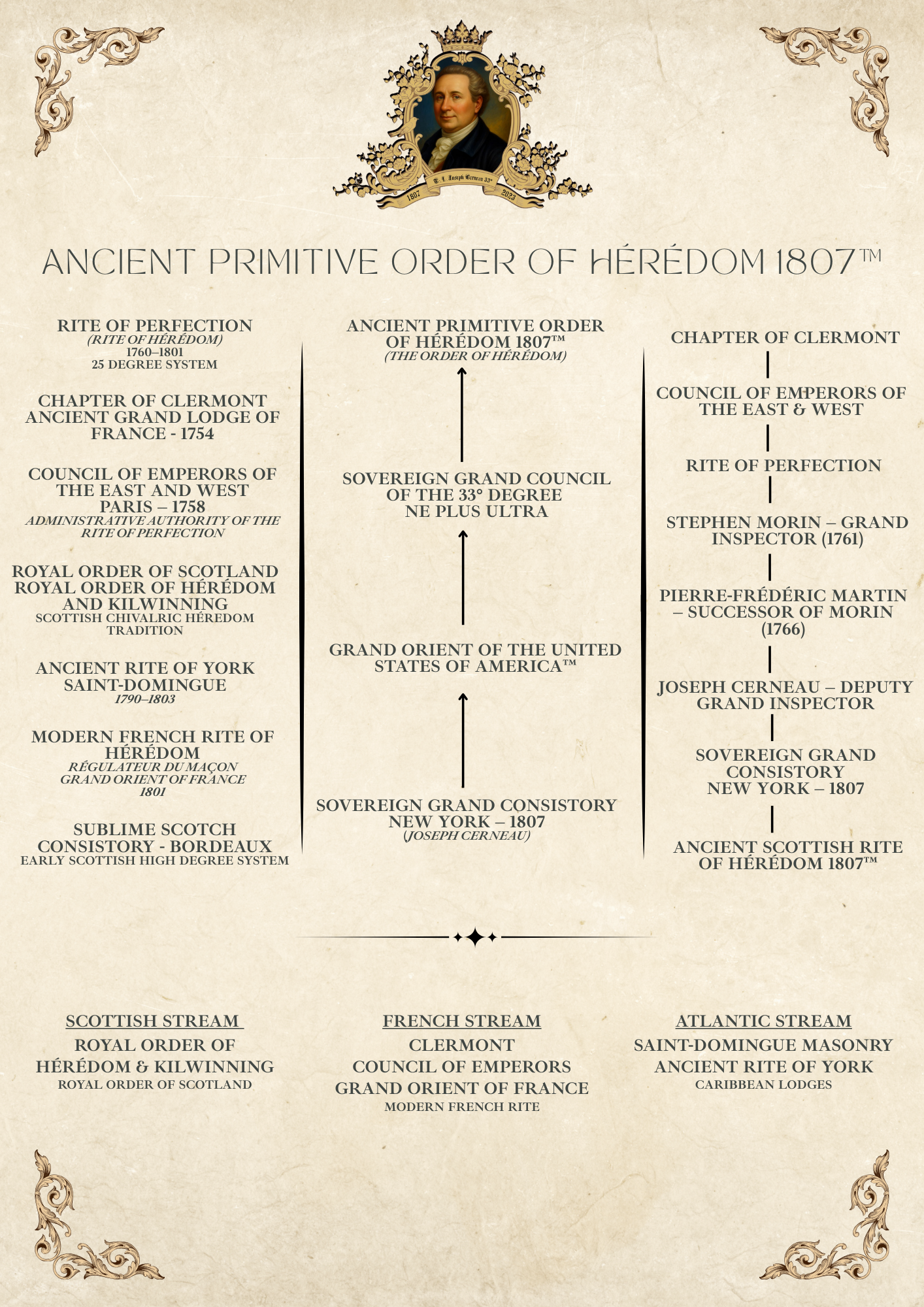
The Ancient Primitive Order of Hérédom 1807™ derives from the Scottish High-Degree system transmitted from the Grand Orient of France through Joseph Cerneau, established in New York in 1807. This lineage was preserved through the Cerneau Supreme Council under Edmund B. Hays, and subsequently transmitted by Harry J. Seymour, Sovereign Grand Inspector General.
Following the Cerneau disruptions of the 1860s, Seymour continued the Rite with the approval of the Grand Orient de France, and transmitted the authority of the Rite to John Yarker, who perpetuated the tradition in Europe.
The documentation of this Cerneau-derived Scottish Rite working is preserved in the Fonds Maçonnique FM4-979 manuscript at the Bibliothèque nationale de France, which records the continuation of the Rite under the authority of Cerneau in New York in 1807.
Through the Yarker transmission the Rite continued through the Scandinavian line and into the present Sovereign Grand Council.
Thus the Ancient Primitive Order of Hérédom 1807™ stands as a continuation of the Cerneau Scottish Rite tradition descending from the Grand Orient of France and preserved through the Seymour–Yarker lineage.
The Ancient Primitive Order of Hérédom 1807™ stands upon foundations laid in the eighteenth century, within the established Masonic culture of France and the French Antilles.
UNIVERSI TERRARUM ARCHITECTONIS MAGNI AD GLORIAM INGENII
SIT LUX ET LUX FUIT
Mother Constitution of the World
Grand Orient of the United States of America of the Ancient Primitive Order of Hérédom 1807™
The Grand Orient of the United States of America works the Ancient French Craft Degrees of Apprentice, Fellow-Craft, and Master Mason as transmitted through the French Antilles and established in the United States in 1807.
It governs symbolic lodges under its obedience and preserves the Craft Constitutions of the Rite within its own sovereign jurisdiction.
Mother Constitution of the World
Sovereign Grand Council of the Thirty-Third Degree Ne Plus Ultra of the Ancient Primitive Order of Hérédom 1807™
The Sovereign Grand Council of the Thirty-Third Degree Ne Plus Ultra preserves the high-grade system of the Ancient Primitive Order of Hérédom 1807™, working the degrees 4°–33° in continuity with the French and Caribbean transmissions of the eighteenth century.
From the Caribbean, the Rite was preserved in Cuba in 1806 and organized in New York in 1807, where its American jurisdiction took permanent root.
Historical Continuity
1761 — Étienne Morin.
The French-Antillean transmission begins its documented course through the Caribbean network of higher degrees.
1768 — Chapter of Clermont.
The High Degrees to the 33rd Degree are created within the Clermont system and carried forward into the broader current of transmission.
1774 — The Caribbean.
Bodies exercising authority over the higher degrees were functioning through councils and inspectors responsible for continuity and transmission.
1780s — Saint-Domingue and Jamaica.
Saint-Domingue emerged as a central point of activity, with Jamaica operating in parallel, sustaining the Rite across the islands.
1785 — Sovereign Grand Consistory of the 32nd Degree, Ne Plus Ultra, Albany, New York.
New York, according to an official Manuscript in 1785, emerged as a central point of activity, with Albany, New York operating in parallel, sustaining the Rite across the Colonies of the United States of America.
1796 — Saint-Domingue.
The organization of the higher degrees reached formal maturity, administered through established councils and tribunals.
1801 — Saint-Domingue.
Despite political upheaval, Masonic activity continued and authority traveled with those entrusted to preserve it.
1804 — Saint-Domingue and France.
Authority was transitioned through De Grasse-Tilly and Delahogue. It emerged as a central point of activity, with France now operating in parallel, sustaining the Rite across Europe.
1806 — Baracoa, Cuba.
Authority was carried from Saint-Domingue to Cuba, where the Rite was preserved intact during displacement.
1807 — New York.
From Cuba, the Rite crossed into the United States. In New York, Joseph Cerneau organized and established the Rite on American soil.
1813 — Paris.
In France, the existing structures of the Rite were formally reaffirmed within the broader continuity of the system.
From these events emerged a complete and independent system, uniting symbolic Craft Masonry and the full progression of higher degrees, preserved through successive custodians and returned to the United States in faithful continuity with its earliest foundations.